Difference Between Information and Data: From Raw Facts to Meaning
Published: 13 Oct 2026
Every website visit, customer purchase, student mark, and temperature reading begins as a small piece of data. However, these facts become useful only when they are organized and explained.
Understanding the difference between information and data shows how raw observations are converted into reports, insights, and decisions. Data provides the basic facts, while information adds meaning and context. Although both are essential in computers, education, business, and research, they serve different purposes.
This guide compares them using simple language, tables, examples, and practical situations.
Short Direct Answer
The main difference between information and data is that data is raw and unprocessed, while information is processed and meaningful.
For example, the numbers 50, 65, 72, and 80 are data. When these numbers are identified as student marks and used to calculate an average score, they become information.
Data provides the basic facts, while information helps people understand those facts and make decisions.
What Is Data?
Data is a collection of raw facts, numbers, words, symbols, measurements, or observations. By itself, data may not provide a clear meaning because it has not yet been organized, analyzed, or placed in context.
Examples of data include:
- A list of customer names
- Website visitor numbers
- Student marks
- Daily temperatures
- Product prices
- Survey responses
- Dates and times
- Images and videos
For example, the numbers 100, 150, 200, and 250 are data. Without additional details, we do not know whether they represent sales, visitors, prices, or something else.
Types of Data
Data can be divided into several categories.
1. Quantitative Data
Quantitative data contains numbers and measurable values.
Examples include:
- Age
- Height
- Price
- Website traffic
- Test scores
- Number of customers
2. Qualitative Data
Qualitative data describes qualities, opinions, or characteristics.
Examples include:
- Customer feedback
- Product color
- User reviews
- Interview answers
- Satisfaction levels
3. Structured Data
Structured data follows an organized format, such as rows and columns.
Examples include:
- Spreadsheets
- Databases
- Customer records
- Sales tables
4. Unstructured Data
Unstructured data does not follow a fixed format.
Examples include:
- Emails
- Images
- Videos
- Social media posts
- Audio recordings
What Is Information?
Information is data that has been processed, organized, analyzed, or explained so that it becomes useful and meaningful.
Information answers questions such as:
- What happened?
- Why did it happen?
- What does the data mean?
- What action should be taken?
- Which result is most important?
For example, a list of monthly sales figures is data. A report showing that sales increased by 20% compared with the previous month is information.
Information helps users understand situations, identify patterns, solve problems, and make decisions.
Common Forms of Information
Information may appear in different forms, including:
- Reports
- Charts
- Tables
- Dashboards
- Summaries
- Recommendations
- Notifications
- Research findings
- Performance analysis
The same data can produce different information depending on how it is processed and interpreted.
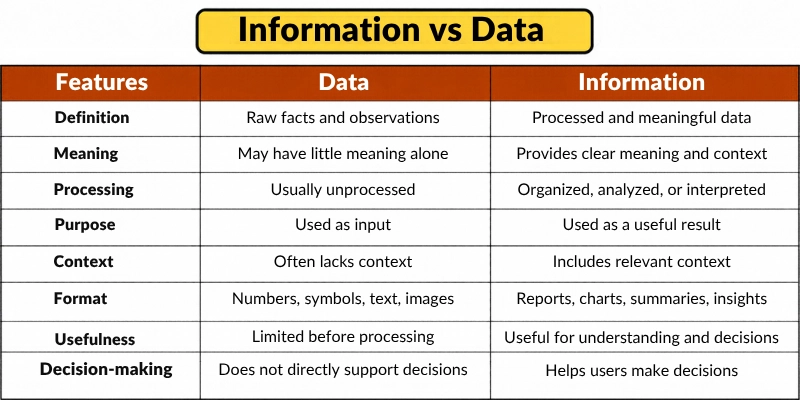
Information vs Data Comparison Table
| Feature | Data | Information |
|---|---|---|
| Definition | Raw facts and observations | Processed and meaningful data |
| Meaning | May have little meaning alone | Provides clear meaning and context |
| Processing | Usually unprocessed | Organized, analyzed, or interpreted |
| Purpose | Used as input | Used as a useful result |
| Context | Often lacks context | Includes relevant context |
| Format | Numbers, symbols, text, images | Reports, charts, summaries, insights |
| Usefulness | Limited before processing | Useful for understanding and decisions |
| Decision-making | Does not directly support decisions | Helps users make decisions |
| Example | Daily website visits | Monthly traffic growth report |
| Role | Starting point | Final or meaningful outcome |
Key Differences Between Information and Data
Data and information are part of the same process, but they differ in meaning, purpose, structure, and usefulness.
1. Data Is Raw, While Information Is Processed
The biggest difference between information and data is their level of processing. Data consists of individual facts that have not yet been studied or organized. It may include numbers, names, measurements, responses, or observations.
Information is created when data is cleaned, arranged, compared, calculated, or explained.
For example, a list of daily website visitors is data. A report showing that website traffic increased by 15% this month is information.
2. Data May Lack Meaning, While Information Provides Meaning
Raw data may be difficult to understand without additional details.
For example:
25, 30, 28, 35
These numbers do not provide a clear message because we do not know what they represent. When we learn that these numbers represent daily product sales, they become more understandable. If they are analyzed to show an increasing sales trend, they become useful information. Information explains what the data means.
3. Data Is Used as Input, While Information Is the Output
In a processing system, data normally enters as input. A computer, person, or application then processes that data and produces information as output. Data starts the process, while information is the useful result produced from it.
For example:
- Student marks are entered as data.
- The system calculates the average.
- The final grade report becomes information.
4. Data Often Lacks Context
Context explains where data came from, what it represents, and why it matters. For example, the number 500 alone has no clear meaning. When we say that a website received 500 visitors in one day, the data has context and becomes more useful information. It could represent:
- 500 website visitors
- 500 products
- 500 customers
- 500 dollars
- 500 survey responses
5. Information Supports Decision-Making
Raw data does not always tell users what action they should take. Information organizes and explains data so that users can make better decisions. This information can help the business decide which product to promote, restock, or improve.
For example, a business may collect sales data from different products. After analysis, the business may discover that one product generates the highest profit.
6. Data Can Be Large and Detailed
Organizations often collect large amounts of data. This raw data can be difficult to understand when viewed all at once. Information usually presents only the most useful findings, such as which traffic source produced the most conversions. For example, a website analytics platform may record:
- Page views
- Clicks
- Sessions
- Traffic sources
- Device types
- Locations
- Conversion events
7. Information Is Usually More Organized
Data may appear in an unorganized list or collection. For example, hundreds of customer survey responses are data. A chart showing that 75% of customers are satisfied is information. Information is normally presented in a clear format, such as:
- A report
- A table
- A graph
- A dashboard
- A summary
- A recommendation
8. Data Can Exist Without Information
Data can be collected and stored without being processed. In that situation, data exists, but useful information has not yet been created. Information cannot normally exist without data because it needs facts, observations, or measurements as its foundation.
For example, a company may store thousands of customer records but never analyze them.
9. Data May Contain Errors
Before data becomes reliable information, it should be checked and cleaned. If the original data is incorrect, the resulting information may also be misleading. This is commonly explained by the phrase “garbage in, garbage out.” Raw data may contain:
- Duplicate entries
- Missing values
- Incorrect numbers
- Spelling mistakes
- Outdated records
- Irrelevant details
10. Information Requires Interpretation
Processing data is not always enough. Users may also need to interpret the results.
For example, website traffic may increase, but this does not automatically mean the business is performing better.
The increase may come from:
- Irrelevant visitors
- Spam traffic
- A temporary trend
- A successful marketing campaign
- A viral social media post
Information becomes more valuable when users understand the reason behind the numbers.
Similarities Between Information and Data
Although data and information are different, they also share some common features.
1. Both Represent Facts
Data contains raw facts, while information explains those facts.
2. Both Can Be Stored Digitally
Computers, databases, spreadsheets, and cloud systems can store both data and information.
3. Both Can Appear in Different Formats
Data and information may include text, numbers, images, audio, tables, and charts.
4. Both Are Useful in Computer Systems
Computers collect data, process it, and produce information for users.
5. Both Can Be Shared
Data and information can be transferred through emails, reports, websites, and digital platforms.
6. Both Require Accuracy
Incorrect data can produce incorrect information, so both should be checked carefully.
When Should You Use Data?
Data is useful when you need to:
- Record individual facts
- Collect evidence
- Conduct research
- Track user activity
- Store customer details
- Measure performance
- Perform calculations
- Create future reports
For example, an SEO professional collects keyword rankings, clicks, impressions, and conversions as data before preparing a performance report.
When Should You Use Information?
Information is useful when you need to:
- Understand results
- Identify patterns
- Make decisions
- Explain performance
- Solve problems
- Create reports
- Compare options
- Recommend actions
For example, a business owner may use information showing which marketing channel produces the most qualified leads.
How Does Data Become Information?
Data becomes information through a series of steps.
1. Data Collection
Raw facts are collected from sources such as:
- Forms
- Surveys
- Sensors
- Websites
- Transactions
- Interviews
- Applications
2. Data Cleaning
Incorrect, duplicate, incomplete, or irrelevant entries are removed or corrected.
3. Data Organization
The data is arranged into categories, tables, databases, or spreadsheets.
4. Data Processing
Calculations, comparisons, filtering, or analysis are performed.
5. Data Interpretation
The results are examined to understand what they mean.
6. Information Presentation
The final information is presented through a report, graph, dashboard, or summary.
Tips for Using Data and Information and Mistakes to Avoid
Follow these simple tips to improve accuracy and avoid misleading results.
Tips
- Collect data from reliable sources.
- Check data for errors and duplicates.
- Add proper labels and context.
- Use clear tables, charts, and summaries.
- Protect confidential data.
- Focus on information relevant to the goal.
Mistakes to Avoid
- Do not treat raw data as a final conclusion.
- Avoid using outdated or incomplete data.
- Do not ignore the context behind numbers.
- Avoid presenting too much unnecessary information.
- Never manipulate data to support a false conclusion.
- Do not share sensitive data without permission.
Conclusion
So guys, in this article, we’ve covered the difference between information and data in detail. Data provides the raw material, while information converts it into useful meaning for reports, analysis, and decisions.
My recommendation is to collect data from reliable sources, remove errors, and present only the information relevant to the user’s goal. Never ignore missing values, outdated records, or the context behind statistics.
Apply these steps when reviewing your next report, and share this technology guide with someone learning data and computer basics.




- Be Respectful
- Stay Relevant
- Stay Positive
- True Feedback
- Encourage Discussion
- Avoid Spamming
- No Fake News
- Don't Copy-Paste
- No Personal Attacks
- Be Respectful
- Stay Relevant
- Stay Positive
- True Feedback
- Encourage Discussion
- Avoid Spamming
- No Fake News
- Don't Copy-Paste
- No Personal Attacks
