10 Surprising Differences Between Science and Technology That Shape the Future
Published: 23 Oct 2025
Science and technology might sound like two sides of the same coin. Both are essential for modern living, driving development and transforming the future. However, they are used for different objectives.
Science aims to understand the world and explain how things work. At the same time, technology takes that knowledge and applies it to solve real-world problems.
In this article, we will explore the difference between science and technology that helps us reveal how these two fields work together to shape our society and improve the way we live.
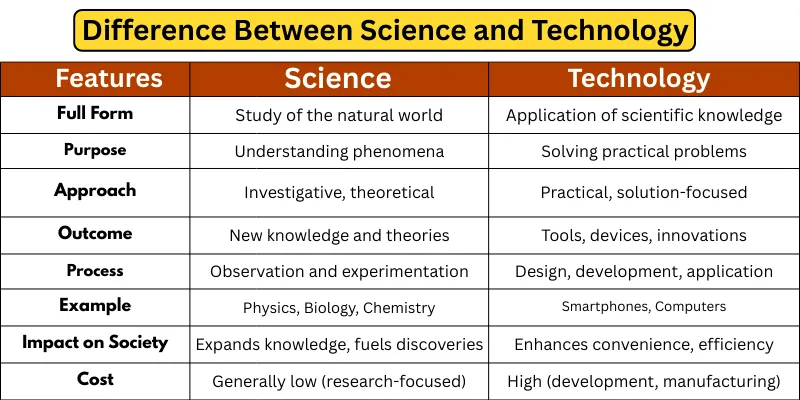
Top 10 Differences Between Science and Technology
The difference between science and technology is essential to understand because both play an important role in shaping our world, but they work in very different ways.
Below is a list of key differences between them:
- Full Form
- Purpose
- Approach
- Outcome
- Process
- Example
- Impact on Society
- Cost
- Advantages
- Disadvantages
Full Form
Science: Science comes from the Latin word “scientia,” meaning knowledge. It refers to the methodical study of the natural world through observation, experimentation, and reasoning.
Technology: Technology comes from the Greek words “techne” (skill) and “logia” (study). It refers to the application of scientific knowledge for practical purposes, especially in industry.
Purpose
Science: The main purpose of science is to discover new facts and develop theories that explain how the world works. It is focused on understanding natural phenomena.
Technology: The primary objective of technology is to apply scientific knowledge to solve real life problems and create tools, machines, and systems that can improve the lifestyle of humanity.
Approach
Science: Science uses the scientific method, which involves creating hypotheses, conducting experiments, collecting data, and drawing conclusions to understand a concept in detail.
Technology: Technology provides a more practical approach, focused on using scientific findings to create tools or structures for use in the real world.
Outcome
Science: The result of science is knowledge. Scientists aim to understand how and why things happen in the natural world. The primary purpose of science is to find reasoning.
Technology: The outcome of technology is products, systems, or tools that are used to make life easier, safer and more efficient.
Process
Science: The scientific process involves experimentation and research to develop new knowledge. It is driven by curiosity and the desire to understand.
Technology: The technological process involves the design, development, and implementation of inventions based on scientific knowledge. The need for practical solutions drives technology.
Example
Science: An example of science would be the discovery of gravity or understanding the laws of physics.
Technology: An example of technology is the invention of the smartphone or the development of the internet.
Impact on Society
Science: Science drives theoretical knowledge, which has the potential to change our understanding of the universe significantly. Its influence is mostly intellectual and fundamental.
Technology: Technology has an influence on society by improving people’s lives, developing communication, medicine, transportation, and a variety of other industries.
Cost
Science: Scientific research may be expensive and time-consuming, requiring significant resources and money.
Technology: Technology can be expensive to create at first, but once established, it is usually made more affordable to the broad population.
Advantages
Here are some Merits or pros of technology and science.
Science:
- It expands our understanding of the world.
- Science leads to new theories and discoveries that shape our knowledge.
- It applies the groundwork for future innovations.
Technology:
- Technology provides practical solutions to real-life challenges.
- It improves efficiency and enhances human life.
- It drives economic growth through innovation.
Disadvantages
Here are some demerits or cons of technology and science.
Science:
- It may take time to translate into practical solutions.
- Current technologies and resources can limit science.
Technology:
- It can sometimes lead to unintentional consequences or moral issues (e.g., environmental concerns, privacy issues).
- Technology may lead to dependency on devices and automation.
Conclusion
So, guys, it’s time to finish up! In this article, we’ve covered the 10 main differences between science and technology. Understanding these differences will help you see how each field drives innovation and shapes our world.
Consider how science and technology affect your everyday life and the world around you.
Want to explore more topics on technology? Check out our other articles for more in-depth understandings of the world of technology and science!
Questions about the difference between science and technology
Below are some common questions people ask about the difference between technology and science.
Science seeks to understand the reasoning in the world, while technology uses that knowledge to create practical solutions. Science is focused on discovery, while technology focuses on innovation.
Examples of science include biology, chemistry and physics.
Examples of technology include smartphones, computers and medical devices.
Science provides the knowledge, and technology uses it to create useful tools. Science helps us understand the world, while technology allows us to use that understanding for practical purposes.
No, technology relies on science. Technology cannot exist without scientific knowledge because it uses the principles and discoveries of science to build tools, machines, and systems.
Science is the methodical study of the natural world. In contrast, technology is the application of scientific knowledge to real-world problems. Together, they enable us to discover the world and solve issues.
Information technology (IT) focuses on the use and management of computer systems and networks. In contrast, computer science focuses on the study of algorithms, software development, and data structures.
Science and technology are closely related to each other. Science establishes the basis of knowledge, and technology uses that information to develop solutions and inventions that improve daily living.




- Be Respectful
- Stay Relevant
- Stay Positive
- True Feedback
- Encourage Discussion
- Avoid Spamming
- No Fake News
- Don't Copy-Paste
- No Personal Attacks
- Be Respectful
- Stay Relevant
- Stay Positive
- True Feedback
- Encourage Discussion
- Avoid Spamming
- No Fake News
- Don't Copy-Paste
- No Personal Attacks
