20 Interesting Facts About Digital Technology That Will Surprise You
Published: 14 Apr 2026
Digital technology changed the world in a very short time. It started with simple tools and now it is part of our everyday life. Today, people use digital technology for learning, working, shopping, and talking to others. Many people use these tools every day, but they do not know many surprising details about them.
In this article, you will read 20 facts about digital technology that are simple, interesting, and easy to understand.
20 Interesting Facts About Digital Technology
Digital technology affects our daily lives in ways many people do not always see. These 20 facts help show how quickly it has spread and how important it is.
1. The first computer mouse was made of wood
The first computer mouse appeared in 1964. Douglas Engelbart built it from wood, and it used two metal wheels to track movement. It looked more like a tiny block from a workshop than the smooth mouse on your desk today.
That early mouse helped people control a cursor on a screen. It was simple, but it opened the door to easier computer use. Small tool, big role.
2. Email came before the web
Email is older than the World Wide Web. Ray Tomlinson sent one of the first network emails in 1971 and used the @ symbol for addresses. The web came later, in 1991.
So yes, people were sending messages online before websites filled your screen. In a way, digital mail showed up before the digital street.
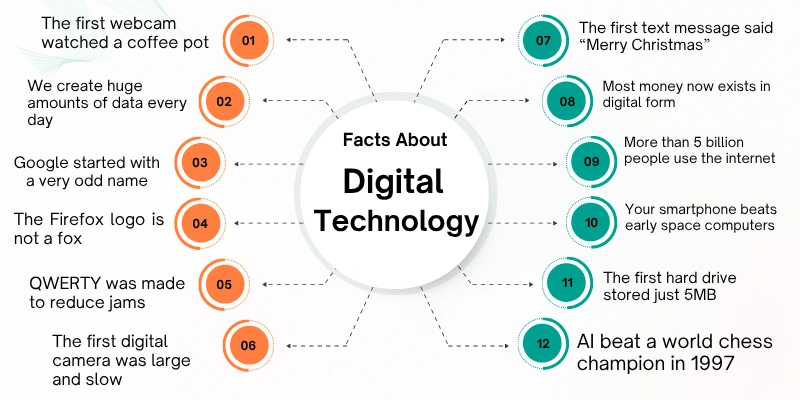
3. The first webcam watched a coffee pot
The first webcam was not built for meetings or online classes. In 1991, researchers at Cambridge University used it to check whether their coffee pot was empty. They wanted answers without leaving their desks.
That idea sounds funny now, but it worked. A simple office problem helped spark a tool now used around the world.
4. We create huge amounts of data every day
Every day, people create a mountain of data. Photos, videos, emails, posts, online forms, and app activity all add to the pile. A common estimate puts daily global data creation in the quintillions of bytes.
That number is so large it almost slips through your fingers. It shows how much of modern life now leaves a digital trail.
5. Google started with a very odd name
Before it became Google, the search engine was called Backrub. The name came from how it looked at backlinks between websites. That sounds strange now, but it made sense at the time.
Later, the name changed to Google. Today, it handles an enormous number of searches every day.
6. The Firefox logo is not a fox
Many people think the Firefox logo shows a fox. The animal is usually described as a red panda, or at least based on that idea. That’s one of those small tech facts that catches people off guard.
The name stuck, and so did the logo. It became one of the best-known browser symbols on the internet.
7. The first computer bug was a real bug
In 1947, engineers found a moth trapped inside a computer relay at Harvard. The insect caused trouble in the machine, and the story helped popularise the word bug for computer faults. That’s about as literal as tech language gets.
Today, when software breaks, people still call it a bug. Funny how one moth left such a long shadow.
8. QWERTY was made to reduce jams
The QWERTY keyboard layout came from typewriters. Its key order helped lower the chance of metal arms jamming when people typed fast. It was a practical fix, not a speed contest.
That layout stayed with us. So the keyboard on your laptop carries a bit of 19th-century baggage into the digital age.
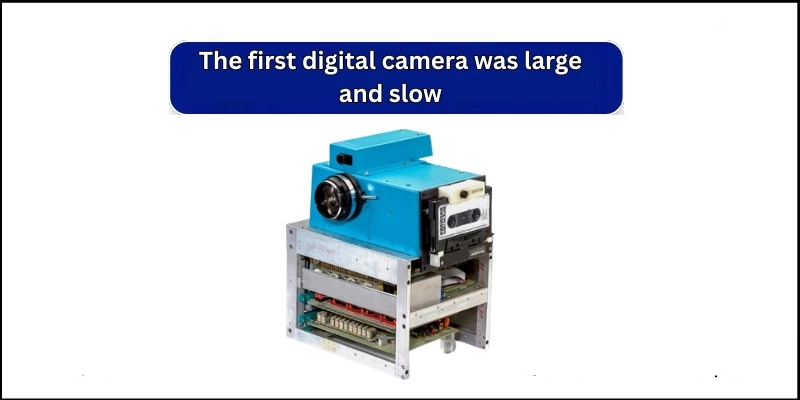
9. The first digital camera was large and slow
Kodak engineer Steven Sasson built an early digital camera in 1975. It weighed about 8 pounds and took around 23 seconds to record one image. By today’s standards, that’s slower than a snail on a rainy day.
The image quality was also low. Still, that bulky device helped start the road to phone cameras and instant photos.
10. The first text message said “Merry Christmas”
The first SMS text message was sent in 1992. The message said, “Merry Christmas.” It went from a computer to a mobile phone.
Now texting is part of daily life for billions of people. That short holiday message was a small start to a huge habit.
11. Most money now exists in digital form
A lot of modern money is not cash you can hold in your hand. It exists as numbers in banking systems, payment apps, and digital records. Cards, transfers, and wallets do much of the heavy lifting.
That means digital technology now sits at the heart of the global economy. When money moves, computers usually move with it.
12. The internet is decades old
The internet did not begin with social media or smartphones. It started as a research network linking institutions and specialists. Over time, it grew into the giant system people use today.
It’s now many decades old. What began as a narrow tool became a worldwide web of work, learning, shopping, and fun.
13. More than 5 billion people use the internet
The internet now reaches a huge part of the world. More than 5 billion people use it for school, work, banking, shopping, and talking to others. For many people, it’s as normal as turning on a light.
That reach shows why digital access matters so much. When someone is offline, they can miss out on far more than entertainment.
14. Your smartphone beats early space computers
The computers used in the Apollo missions were strong for their time. But the smartphone in your pocket can do far more. It handles apps, video, internet access, maps, and messages in seconds.
That’s a wild thought. A tool you use to check the weather has more computing power than early machines used for moon missions.
15. Most of the world’s data is new
A huge share of the world’s digital data was created in recent years. That’s because people post more, stream more, record more, and store more than ever before. The tap is running full blast.
This matters because storing and managing data is now a major job. It also raises questions about privacy, security, and who controls all that information.
16. Bots make up a large part of web traffic
Not every website visit comes from a person. Many come from bots, which are automated programs. Some are useful, like search engine crawlers, while others can spam, scrape, or attack sites.
That means a big part of the web runs behind the curtain. The internet is busy even when people are asleep.
17. The first hard drive stored just 5MB
IBM built the first hard drive in 1956. It could store about 5 megabytes of data and was massive in size. Today, even a tiny USB drive can hold far more.
That shows how far storage has come. What once filled a room can now fit in your pocket.
18. AI beat a world chess champion in 1997
In 1997, IBM’s Deep Blue defeated world chess champion Garry Kasparov in a match. That moment grabbed global attention. It showed that computers could beat top humans in some complex tasks.
Chess became a public stage for machine power. It was one of those moments that made people stop and stare.
19. YouTube gets huge amounts of video every minute
YouTube receives a massive flood of video uploads. A common figure says more than 500 hours of video are uploaded every minute. That’s more footage than any one person could watch in many lifetimes.
This also shows how much work happens behind the screen. Video platforms need vast server systems to store, sort, and stream all that content.
20. Billions of Google searches happen each day
Google handles billions of searches every day. People use it to ask questions, check facts, find news, compare products, and solve problems. For many users, it’s the front door to the internet.
That’s why search matters so much. When you need an answer fast, search engines often become your first stop.
The Evolution of Digital Technology
Digital technology did not grow in one day. It took many years of hard work, new ideas, and small steps that slowly changed the world.
- 1940s – First Computers
The first computers were very large. Some machines, like ENIAC, filled a whole room.
They were also much slower and weaker than today’s phones. Still, they laid the first brick in the road of digital progress.
- 1960s – First Computer Mouse
In the 1960s, Douglas Engelbart created the first computer mouse. It was made of wood and had only one button.
- 1970s – Email Begins
In the 1970s, Ray Tomlinson sent the first email. He also helped make the “@” symbol part of email addresses.
- 1980s–1990s – Internet Era
The internet changed everything. In 1991, the World Wide Web opened a new door for people to share and find information.
- 2000s – Mobile Boom
The 2000s brought a huge rise in mobile phones and smartphones. People could now carry digital tools in their pockets.
- 2010s–2020s – AI & Cloud
AI, machine learning, and cloud computing shape modern life. Siri, Alexa, Google Drive, and blockchain are everyday examples.
- 2021 to 2026 – Everyday AI and Faster Networks
From 2021 to 2026, AI became part of daily life, and ChatGPT’s public launch in November 2022 helped speed that change.
At the same time, 5G kept expanding worldwide, making internet access faster and supporting more digital services.
Conclusion
So, friends, we are almost done. In this post, we talked about 20 facts about digital technology. These facts show how useful and important digital technology is in our daily life.
Today, we use digital technology for learning, working, shopping, and talking to others. I hope you learned something new from these facts.
If you liked this article, share it with your friends and keep exploring more about the types of digital technology.
Frequently Asked Questions
Want to understand the facts of digital technology better? These FAQs give quick and easy answers.
Digital technology has evolved from basic computing machines to advanced systems like artificial intelligence, cloud computing, and the internet.
It started with early computers in the mid-1900s, then came personal computers, the internet, and mobile devices. Today, new tools like AI, large amounts of data, and automated machines are changing how people work, learn, and communicate.
The leading companies in digital technology innovation include Apple, Microsoft, Google, Amazon, and Meta.
These companies create new tools like online storage, smartphones, smart computer programs, and software. They spend a lot on research and keep coming out with new products that change technology worldwide.
The most popular digital devices used in everyday life are smartphones, laptops, tablets, smartwatches, and smart TVs.
People use smartphones for communication and internet access, laptops for work and study, tablets for reading and media, smartwatches for fitness tracking, and smart TVs for entertainment.
The best cloud storage services include Google Drive, Dropbox, Microsoft OneDrive, and iCloud.
These platforms allow users to save, open, and share files online from any device. They have safety tools, file-backup options, and simple ways to organise files for both personal and work use.
You can get jobs such as software developer, data analyst, digital marketer, cybersecurity expert, IT support specialist, and web designer.
Digital technology skills are in high demand across many industries. These roles involve creating software, analysing data, managing online marketing and maintaining digital platforms.
The 6 ages of technology are the Stone Age, Bronze Age, Iron Age, Industrial Age, Information Age, and Digital Age.
Each age of technology represents a significant transformation in how humans use tools. The Digital Age is the current era in which computers, the internet, and digital systems play a central role in daily life.
20/20 technologies are new technologies that became very important around 2020, such as artificial intelligence, cloud computing, remote work tools, and automation.
They still affect how companies work and how people use technology today.


- Be Respectful
- Stay Relevant
- Stay Positive
- True Feedback
- Encourage Discussion
- Avoid Spamming
- No Fake News
- Don't Copy-Paste
- No Personal Attacks
- Be Respectful
- Stay Relevant
- Stay Positive
- True Feedback
- Encourage Discussion
- Avoid Spamming
- No Fake News
- Don't Copy-Paste
- No Personal Attacks
