10 Types of Information Technology Every Business Needs to Know
Published: 21 Nov 2025
Feeling confused by the world of Information Technology? You’re not alone! With so many different types of IT, it can be hard to know where to start. But understanding the basics doesn’t have to be difficult.
In this article, we’ll break down the main types of Information Technology in a simple way so that you can make the right choices without the stress. Ready to learn how IT impacts your daily life and business? Let’s get started!

Types of Information Technology
Information technology (IT) is a vast field with several categories, each of which plays an important role in determining how we interact with the digital world. From the devices we use to the software we depend on, each kind of IT serves a unique role.
Let’s explore the 10 main kinds of Information Technology and understand how they impact our daily lives and businesses.
- Hardware Technology
- Software Technology
- Networking Technology
- Cybersecurity Technology
- Cloud Computing Technology
- Data Analytics Technology
- Artificial Intelligence (AI) and Machine Learning (ML)
- Database Management Technology
- Internet of Things (IoT) Technology
- Blockchain Technology

1. Hardware Technology
Hardware technology refers to the physical components of a computer system. These are the actual components of technology that allow anything from personal computers to servers to function smoothly.
Key Features:
- For durability, they are often made of strong metals such as aluminum.
- Contains cooling fans or effective heat dissipation mechanisms.
- Contains high-performance processors for faster computations.
- Built with ports for multiple device connections (USB, HDMI).
- Battery life is designed to support extended usage without regular charging.
Examples:
Some of the most common examples of Hardware Technology are the Central Processing Unit (CPU), Storage Devices and devices like printers, scanners and monitors.
2. Software Technology
Software technology refers to the programs and applications that run on hardware and allow users to interact with the system. It includes both system software and application software.
Important Features:
- User-friendly interfaces for easy navigation and relations.
- Regular updates to improve features and security.
- It’s accessible with various devices and operating systems.
- It provides us with flexibility by operating both offline and online.
- Provides automated backups to prevent data loss.
Examples:
Some of the most common examples of Software Technology are the Operating Systems, business applications, gaming applications and online streaming platforms like Netflix.
3. Networking Technology
Networking technology connects multiple devices to share information, resources, and internet access. It ensures that data flows seamlessly across PCs, servers, and mobile devices.
Important Features:
- Offers high-speed data transfer across networks.
- Reliable encryption techniques are used to secure data during transmission.
- It provides us with reliable connectivity for both local and remote access.
- Supports wireless and wired connection options for flexibility.
- Simple flexibility to meet expanding network demands.
Examples:
Local Area Network (LAN), Wide Area Network (WAN) and Cloud Networks are the important examples of networking technology.
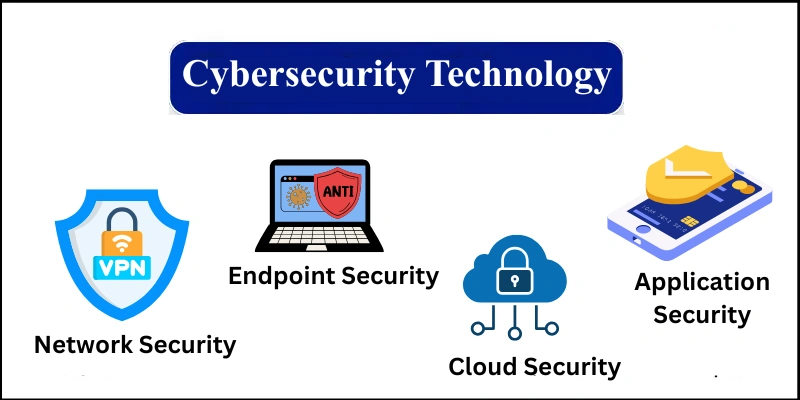
4. Cybersecurity Technology
Cybersecurity technology aims to protect systems, networks, and data from cyber-attacks, theft and destruction. This technology is essential in an era where personal and commercial data are continuously at risk.
Important Features:
- Monitors and detects unauthorized access in real-time.
- This technology uses encryption protocols to protect personal data.
- Multi-layered protection against viruses and cyber threats.
- Firewalls are used to prevent external attacks.
- Regular security patches to ensure up-to-date protection.
Examples:
Firewalls, data encryption, and antivirus software are the best examples of cybersecurity technology.
5. Cloud Computing Technology
Cloud computing allows users to save, organize, and analyze data over the internet rather than on local servers or personal devices. It provides unlimited resources, adaptability and affordable prices.
Important Features:
- Offers scalable storage solutions based on usage needs.
- Provides remote access from any device with internet connectivity.
- Minimize the need for local physical infrastructure.
- Uses automated backups for data safety and recovery.
- Provides cost-effective subscription plans.
Examples:
Public Cloud, Private Cloud and Hybrid Cloud services are the key examples of Cloud computing technology.
6. Data Analytics Technology
Data analytics looks into unstructured data to obtain relevant insights that could help organizations in making intelligent choices. It uses a variety of tools and techniques to analyze massive amounts of data, identify patterns and predict future trends.
Important Features:
- Processes massive databases to provide valuable insights.
- Data is presented using graphs and charts to facilitate easier understanding.
- Compatible with commercial tools to enable smooth reporting.
- Supports statistical analysis for predicting future trends.
- Optimized to handle structured and unstructured data.
Examples:
Business Intelligence (BI) tools like Tableau, big data analytics and predictive analytics using algorithms are the best examples of Data analytics technology.
7. Artificial Intelligence (AI) and Machine Learning (ML)
AI refers to machines that can affect human intelligence. At the same time, ML is a subcategory of AI that enables machines to learn from data and improve over time without explicit programming.
Important Features:
- Learn from recorded data to improve accuracy over time.
- Automates repetitive tasks to enhance efficiency.
- Processes natural language inputs like voice or text.
- Capable of processing massive databases for pattern identification.
- Continuously improves according to feedback and data analysis.
Examples:
Natural Language Processing (NLP), computer vision and self-driving cars are the most common examples of artificial intelligence and machine learning Technology.
8. Database Management Technology
Database management consists of storing, maintaining, and organizing data in a structured way to facilitate access and recovery. It is essential for organizations that rely heavily on large amounts of data.
Important Features:
- Organizes and stores data efficiently in structured formats.
- Allows for multi-user access while maintaining reliable information consistency.
- Allows for quick access through query processing.
- Provides regular backups to ensure data security.
- Includes reliability of data techniques to ensure accuracy.
Examples:
Relational Database systems like MySQL and PostgreSQL, NoSQL Databases such as MongoDB and Cassandra and Cloud Databases are examples of Database management technology.
9. Internet of Things (IoT) Technology
The Internet of Things (IoT) is a network of physical items such as cars and appliances equipped with sensors and software that interact by exchanging data through the internet.
Important Features:
- Connects multiple devices for smooth and efficient data exchange.
- Performs operations using real-time data.
- Data is collected using sensors for evaluation and selection purposes.
- Allows for online control and tracking with mobile apps.
- Optimized for sustainability in linked devices.
Examples:
Smart home devices, wearable devices and connected cars are widely used examples of IoT technology.
10. Blockchain Technology
Blockchain is an independent, shared database system that enables safe, transparent, and secure transactions. It is most known for empowering cryptocurrencies such as Bitcoin but it also has several other applications.
Important Features:
- Distributed transactions to increase transparency.
- Offers safe and encrypted data communication.
- Creates unaltered records using unchangeable ledgers.
- Smart agreements enable the automated execution of contracts.
- Enables direct person-to-person transfers.
Examples:
Cryptocurrencies, smart contracts and supply chain management are the key examples of Blockchain technology.
Question about Different Types of Information Technology
Here you’ll find the FAQs about the core area of Information Technology.
Here is the list of best examples of IT devices:
- Desktop Computers
- Laptops
- Servers
- Routers/Switches
- Storage Devices (HDDs, SSDs, NAS)
Here is the list of most trending careers choices in IT sectors.
- Software Developer
- Network Administrator
- Cybersecurity Analyst
- Data Scientist
- IT Project Manager
Here is the list of seven IT domains that define different security and management areas. They help businesses protect data and maintain smooth IT operations.
- User Domain
- Workstation Domain
- LAN Domain
- LAN-to-WAN Domain
- WAN Domain
- Remote Access Domain
- System/Application Domain
To succeed in IT, you need both technical and soft skills. These skills such as problem-solving and networking are essential for getting ahead in your job.
- Networking & System Administration
- Programming (Python, Java, C++)
- Cybersecurity Fundamentals
- Cloud Computing (AWS, Azure, GCP)
- Database Management
- Problem-Solving & Critical Thinking
- Communication & Project Management
Businesses rely on IT to stay competitive. It improves productivity, protects data and enables smarter decision-making.
- Improves efficiency & automation
- Enhances communication & collaboration
- Secures data
- Provides insights
- Supports scalability & remote work
IT helps data protection by using encryption, firewalls, antivirus software, and access control systems. These technologies protect sensitive information from cyber threats, ensuring that data remains confidential and secure.
IT helps reduce environmental impact. Here are some techniques to promote greener practices.
- Reducing paper via digital systems
- Enabling remote work
- Smart energy management (IoT)
- Virtualization & cloud use
- Recycling & green IT
Specialized IT services enhance business efficiency and security by providing the best solutions for managing infrastructure, optimizing workflows and ensuring data protection.
These services include network management, cybersecurity, surveillance of systems, and cloud computing.
IT infrastructure, databases, and system repairs and routine maintenance are among the most fundamental components of IT.
Information technology infrastructure consists of physical and virtual resources like servers and networks. System maintenance helps to guarantee that hardware and software systems work well while databases store and organize data.
The types of information technology (IT) courses include software development, network administration, cybersecurity, data science, database management, cloud computing and IT support.
These courses teach students about different areas of IT to help them become better at handling, protecting, and creating tech solutions.
Conclusion
So tech lovers, it’s time to finish this blog post on the different types of Information Technology. I hope this guide helps you understand what each one is about and how it fits into your needs. Personally, I think cloud computing is really useful because it makes data storage and access so much easier.
What do you think? Feel free to share your thoughts in the comments below.
Please don’t forget to check out more helpful articles on tech basics on Complete Tech Guide!

- Be Respectful
- Stay Relevant
- Stay Positive
- True Feedback
- Encourage Discussion
- Avoid Spamming
- No Fake News
- Don't Copy-Paste
- No Personal Attacks
- Be Respectful
- Stay Relevant
- Stay Positive
- True Feedback
- Encourage Discussion
- Avoid Spamming
- No Fake News
- Don't Copy-Paste
- No Personal Attacks
