Top 10 Data Labelling Tools: Paid & Free to Speed Up Your Project
Published: 4 Mar 2026
Are you tired of struggling with data labelling? With so many tools available in the market, it can be hard to choose the right one according to your requirements.
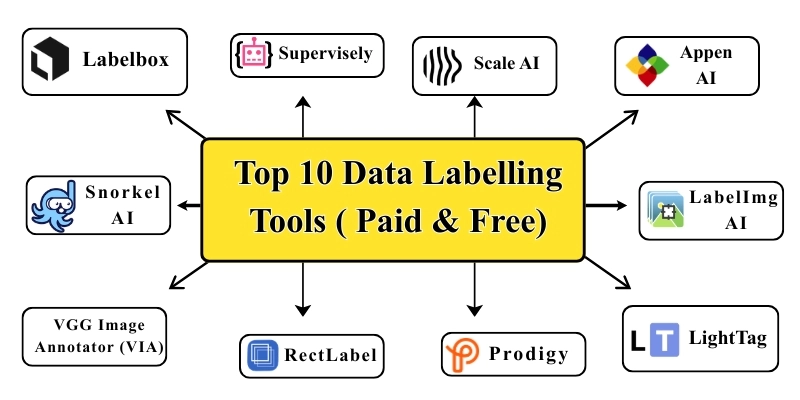
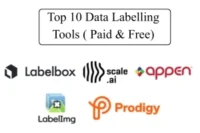
That’s why we’ve made a list of the Top 10 Data Labelling Tools, with 5 paid and 5 free tools that will help you save time, get better results and make the process easier, no matter how big or small your project is.
Why Data Labelling Matters
Labelling data is a key part of controlled learning. Models learn from labelled data and use it to make predictions.
Data labelling tools help make the process faster, more consistent, and ensure you get better-quality information, whether you’re working with narration, pictures, or text.
Here’s why data labelling AI tools are important:
- Training Models: Labels help make training samples that are good.
- Predictions made by the model are more accurate when the labels are correct.
- With the right tools, marking can be done faster and automatically.
- Scalability: It’s important to have tools that can handle more data as your information grows.
Businesses may use the correct tools to guarantee that their models are trained on reliable and labelled data.
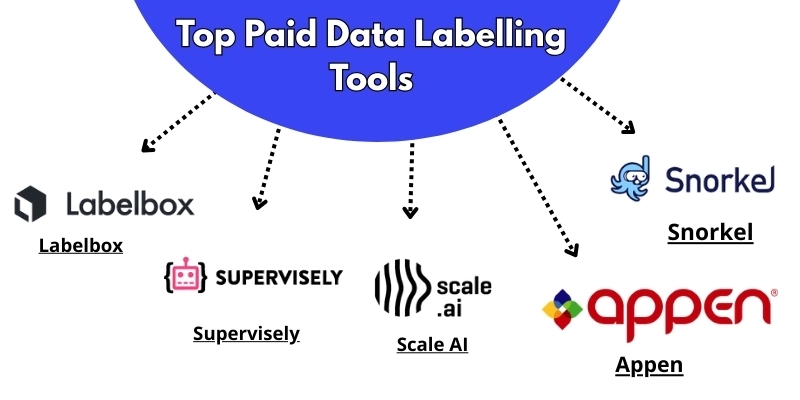
Top Paid Data Labelling Tools
Paid data labeling tools usually provide advanced features like collaboration possibilities, the ability to handle massive files, interaction with other platforms, and support for different types of data (like images, videos, and text).
1. Labelbox
Best for: Scalable image and video labeling for AI projects
Price: Starts at $15,000/year (enterprise pricing)
Labelbox is one of the most popular data labeling tools, with a simple interface for highlighting pictures, videos, and different types of data. It is widely recognized for its effective capabilities, growth potential, and adaptability.
Key Features:
- Labeling of images, videos, and text data
- Tools for teams to work together
- Works with machine learning models to give input and help with improvement
- AI will help with labeling to speed up the process.
Company Info:
- Revenue: US$100 million (estimated)
- Employees: 200+
- CEO: Manu Sharma (Co‑founder & CEO)
- Founded: 2018
- Headquarter: San Francisco, California, USA
- Parent Company: Labelbox, Inc.
2. Supervisely
Best for: Computer vision and AI model training
Price: Contact for pricing
Supervisely is a tool for computer vision projects that lets you mark data. This tool is used for different kinds of annotations such as finding objects, separating them in half, and naming 3D point clouds.
Key Features:
- Segmentation of images, bounding boxes, and keypoint labeling are all supported.
- Comes with built-in tools for annotating different types of data.
- It’s scalable and you can install it in the cloud or locally.
- Adding machine learning tools to the system
Company Info:
- Revenue: US$1.4M (estimated)
- Employees: 100+
- CEO: Denis Drozdov (Founder, Co-CEO)
- Founded: 2017
- Headquarter: Estonia
- Parent Company: Supervisely
3. Scale AI
Best for: High-quality, large-scale data labeling
Price: Contact for pricing
Scale AI is a top data annotation tool for training AI. It provides accurate labeled data for tasks such as computer vision, natural language processing (NLP), and other machine learning tasks. Large companies use it to solve problems of complex data.
Key Features:
- The company offers image, text, and video labeling services.
- This tool offers tailored workflows to handle large-scale projects.
- The system of Scale AI interacts with humans to ensure high-quality labeling.
- Simple integration with machine learning algorithms
Company Info:
- Revenue: US$870 million (estimated)
- Employees: 1,200 (2025)
- CEO: Jason Droege
- Founded: 2016
- Headquarter: San Francisco, California
- Parent Company: Scale AI, Inc.
4. Appen
Best for: Data labeling for NLP and AI projects
Price: Contact for pricing
Appen is a reliable data labeling service that provides human-annotated data for machine learning models. It offers labeling for text, images, and audio to support multiple languages.
Key Features:
- Annotations made by humans for different types of data
- Those who work in NLP, voice recognition, and computer vision
- Offers big jobs for annotation
- Volunteering around the world for a wide range of flexible data tagging
Company Info:
- Revenue: US$447.3 million in 2026 (estimated)
- Employees: 1,000+
- CEO: Ryan Kolln
- Founded: 1996
- Headquarter: Sydney, Australia
- Parent Company: Appen Limited
5. Snorkel
Best for: Weak supervision and semi-automated data labeling
Price: Contact for pricing
Snorkel is a platform that uses “weak supervision,” which means it works with noisy or inaccurate labels and automatically learns the best labels for the data. It’s great for projects with limited labeled data.
Key Features:
- Labeling data partially automatically with little supervision
- Works with current algorithms for machine learning
- Helps turn inaccurate information into high-quality named datasets
- Customizable labeling rules
Company Info:
- Revenue: US$238 million (estimated)
- Employees: Around 500‑800+ employees globally
- CEO: Alex Ratner
- Founded: 2019
- Headquarter: Redwood City, California, USA
- Parent Company: Snorkel AI, Inc.
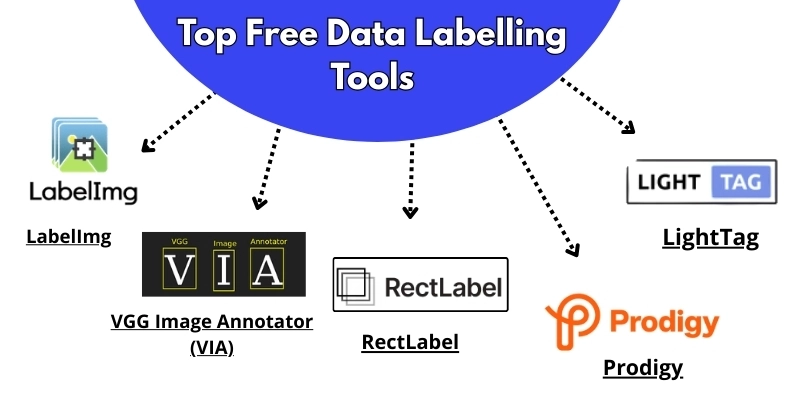
Top Free Data Labelling Tools
Individuals, entrepreneurs, and small teams dealing with smaller datasets may consider using free data labeling tools. While they may not have as many capabilities as premium products, they are still useful for various purposes.
6. LabelImg
Best for: Image annotation for object detection tasks
Price: Free (Open Source)
LabelImg is an open-source data labeling tool and software that is mostly used for image annotation in identifying objects. It enables users to draw boundary lines around objects in photos, which is beneficial for training computer vision models.
Key Features:
- Simple and user-friendly image annotation tool
- Supports the Pascal VOC and YOLO formats.
- Freely available and free to use tools for data tagging.
- Lightweight and no installation is necessary.
Company Info:
- Revenue: Open-source tool (no company revenue)
- Employees: Community-driven
- CEO: (community-driven on GitHub).
- Founded: Initially released around 2016 by Tzutalin (developer from MIT)
- Headquarter: community-based project
- Parent Company: open-source project
7. VGG Image Annotator (VIA)
Best for: Image and video annotation for research
Price: Free (Open Source)
VGG Image Annotator (VIA) is an open-source tool used for data labelling developed by the Visual Geometry Group at Oxford. It’s ideal for image and video annotation and is widely used for research purposes.
Key Features:
- Allows you to add bounding boxes, polygons, and landmarks.
- There is no need for an online computer server for the application to work.
- Free to use and open source
- Allows you to add notes to both images and videos
Company Info:
- Revenue: Open-source tool (no company revenue)
- Employees: Community-driven
- Founder: No corporate leadership since it’s an open‑source project
- Founded: 2016
- Headquarter: Global community project with no central office
- Parent Company: Independent open‑source project developed by the Visual Geometry Group (VGG)
8. RectLabel
Best for: Image labeling for object detection and segmentation
Price: Free trial (Paid version $29.99)
RectLabel is a data labeling tool for macOS that helps with annotating images and videos. It is useful for creating datasets for computer vision models.
Key Features:
- It can find objects and mark them in segments.
- Makes it easy to export labeled data in several different forms.
- There is a free trial version available, as well as an affordable paid version.
- It works with macOS.
Company Info:
- Revenue: Paid app (~$99 one-time Pro license); no subscription revenue model.
- Employees: Independent software project
- Founder: Solo-developed by Ryo Kawamura
- Founded: 2017
- Headquarter: Independent project which is distributed globally via Apple’s App Store
- Parent Company: Independent developers
9. Prodigy (Free Trial)
Best for: Active learning and human-in-the-loop annotation
Price: Free trial available (Paid plans start at $390/year)
Prodigy is an offline data labelling tool designed for efficiency. It allows users to annotate text, images, and more. This AI data labelling tool focuses on human-in-the-loop workflows to improve machine learning models.
Key Features:
- Active learning and model-based writing are supported.
- Labeling of text, images, and videos
- Easy-to-use interface with customizable processes
- There is a free sample and reasonable prices.
Company Info:
- Revenue: $101.5 million in 2026
- Employees: 240+
- CEO: Alexander Peters (Co-Founder & Co-CEO)
- Founded: 2011
- Headquarter: Oakville, Canada
- Parent Company: Explosion AI
10. LightTag (Free Plan)
Best for: Team-based text annotation
Price: Free plan available (Paid plans start at $249/month)
LightTag is a collaborative data labeling tool for teams working on text-based projects. It provides annotation for various applications, including recognition of named entities and text classification.
Key Features:
- Collaborative text annotation for teams
- Supports named entity recognition and text classification
- Free plan with basic features
- Customizable workflows
Company Info:
- Revenue: Not publicly disclosed
- Employees: Small team (~10–30 staff)
- Founder: Tal Perry (Founder of LightTag)
- Founded: 2018
- Headquarter: Berlin, Germany
- Parent Company: LightTag
Tips for Choosing the Right Data Labelling Tool
When choosing a tool for data labelling, consider the following points to choose the best one:
Use Case: Do you label images, text, or videos? Choose a tool compatible with your data type.
Scale: Larger projects require scalable tools, whilst smaller datasets can use free tools.
Integration: Select a tool that is compatible with your existing process and machine learning procedure.
Pricing: Free tools are appropriate for basic projects, but paid tools or software provide additional functionality and support.
Team Collaboration: If you have a team, look for technologies that allow several users to work together.
Final Thoughts
So, tech lovers, it’s time to conclude this article!! We’ve covered the Top 10 Data Labelling Tools, from best paid options such as Labelbox, Scale AI, and Supervisely to free tools like LabelImg, VGG Image Annotator and LightTag.
For smaller teams or personal projects, I personally recommend you to start your journey with LabelImg or LightTag since they’re easy to use and effective.
Try one of these data labeling vs data tagging tools today and start building better datasets for your machine learning models!
If you want to explore more about the latest technologies, then check out our Technology Tool category.
FAQs
The best data labeling tools for computer vision are Supervisely, Labelbox, and VGG Image Annotator (VIA).
These tools offer a variety of tagging styles, including object identification, segmentation, and image labeling, making them perfect for computer vision applications.
Labelbox, Appen, and Scale AI are excellent tools for healthcare AI data labeling.
They assist with labeling medical photos, text, and other healthcare data, ensuring that machine learning models are as accurate as possible.
Prodigy, LightTag, and Snorkel are the best tools for NLP data labeling.
These tools are specifically built for text annotation and can help with tasks such as named entity recognition, text categorisation, and analysis of emotions.
LabelImg, LightTag, and RectLabel are ideal for e-commerce data labelling.
They allow e-commerce enterprises to improve their search and algorithmic suggestions by annotating product photos, text descriptions, and categorizations.
Scale AI, Supervisely, and Labelbox are effective for robotics data labeling.
These technologies are used for labeling sensor data, 3D point clouds, and pictures, which are required for training robots and a self-learning system

- Be Respectful
- Stay Relevant
- Stay Positive
- True Feedback
- Encourage Discussion
- Avoid Spamming
- No Fake News
- Don't Copy-Paste
- No Personal Attacks
- Be Respectful
- Stay Relevant
- Stay Positive
- True Feedback
- Encourage Discussion
- Avoid Spamming
- No Fake News
- Don't Copy-Paste
- No Personal Attacks
