Top 10 Advantages and Disadvantages of Digital Technology in Daily Life
Published: 25 Mar 2026
How often do you use devices, apps, or online systems each day? Digital technology shapes how we work, communicate, and live every day.
Understanding the advantages and disadvantages of digital technology helps you use it wisely.
Curious about how digital technology is influencing your personal and professional world? In this article, you’ll discover its main pros and cons and what they mean for you.
What Is Digital Technology?
Digital technology includes tools and systems that use digital signals (0s and 1s) to store, process, and share information. These digital signals make devices fast and accurate, turning data into numbers and transferring it instantly between devices.
Any device that uses the internet or handles electronic data can be considered digital technology
Major Advantages of Digital Technology
Digital technology improves communication, education, business, and healthcare. Let’s look at the key benefits in simple points.
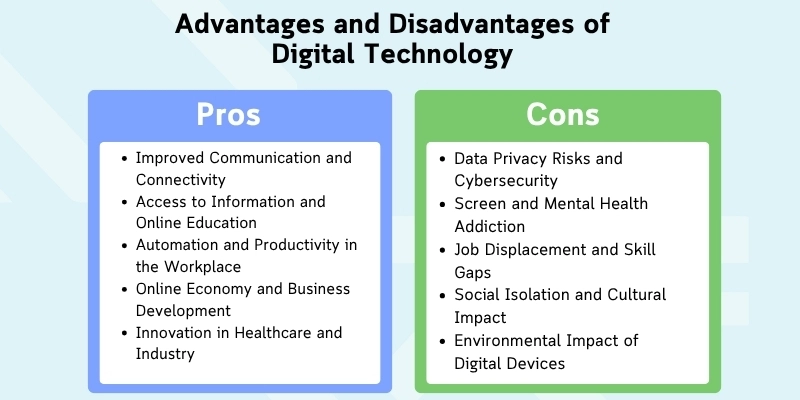
- Improved Communication and Connectivity
- Access to Information and Online Education
- Automation and Productivity in the Workplace
- Online Economy and Business Development
- Innovation in Healthcare and Industry
1. Improved Communication and connectivity.
Online technologies assist individuals to communicate in real-time.
- Social media has 5 billion users all over the world.
- Face to face meetings at any place are made possible through video calls.
- Companies are operating literally and not physically across the world.
- Many individuals have jobs at their place of residence.
Example: Instagram and WhatsApp will enable a small company to sell its goods all over the world.
International communication is fast and less expensive through digital communication.
2. Access to Information and Online Education
Technology simplifies and liberalizes learning.
- Students also enroll in online courses at their homes.
- MOOCs and other platforms offer classes at no charge and for a fee.
- The digital capability of the people is enhanced on a daily basis.
- Rural students receive the same content as urban students.
For example: A student can learn to code on YouTube without taking a real-life course. As a result, education has become highly flexible and affordable.
3. Automation and Productivity in the Workplace
Automation refers to machines performing tasks independently.
- AI software responds to queries posed by customers.
- Robots work in factories.
- Computers process the information within a few seconds.
- Companies save time and costs.
Peak productivity is boosted by automation. But it can also substitute for certain jobs. Later on we will address this risk.
4. Online Economy and Business Development
Businesses can expand with the help of digital systems.
- Through e-commerce, online selling is possible.
- Payments are made with ease through digital banking.
- People are making money online as freelancers.
- Remote working ensures flexibility.
Case study: An artist may operate on behalf of international customers.
Due to digital tools, new income opportunities have emerged.
5. Innovation in Healthcare and Industry
Medical care and production systems are enhanced through technology.
- Telemedicine links medical practitioners and patients through the Internet.
- Smart devices are used to monitor health data.
- Intelligent factories increase production speed.
- Firms benefit through the use of data.
The technology enhances quality and efficiency in most fields.
Major Disadvantages of Digital Technology
Digital technology brings many benefits. But it also creates serious risks. Let’s look at the main disadvantages in simple and clear points.
- Data Privacy Risks and Cybersecurity
- Screen and Mental Health Addiction
- Job Displacement and Skill Gaps
- Social Isolation and Cultural Impact
- Environmental Impact of Digital Devices
1. Data Privacy Risks and Cybersecurity
There is much personal data that is stored in digital systems. This creates security risks.
- Hacking: Hackers gain access to systems and steal
- Leaked user information: Sometimes companies accidentally leak user information.
- Surveillance capitalism: Companies gather and market user data for advertising.
- Identity theft: These criminals steal information and use it to create a fake account.
Example: If a person breaks into your email, they can change your passwords and use your bank account.
Tip: Whenever possible, use a very strong password and 2-step verification.
2. Screen and Mental Health Addiction
Excessive screen time is not good for mental health.
- Social media has a lot of pressure on people which makes them anxious.
- Online funk comparison can cause depression.
- Reward systems use an app-based approach to build dopamine cycles. This causes users to repeatedly check their phones.
- The scrolling is constant and this decreases attention span.
Have you ever spent 5 minutes on opening your phone and 1 hour using it? That is digital addiction.
Hint: Have a limit on screen time and take frequent breaks.
3. Job Displacement and Skill Gaps
Automation changes the job market.
- AI replaces repetitive roles like data entry or cashier jobs.
- Workers must learn new digital skills.
- Some people cannot afford training. This increases economic inequality.
Example: Self-checkout machines reduce the need for store cashiers.
Tip: Learn digital skills like data analysis or online marketing to stay competitive.
4. Social Isolation and Cultural Impact
Technology connects people online. But it can reduce real-life interaction.
- People spend less time in face-to-face conversations.
- Social media creates unhealthy comparison.
- The digital divide separates people who have internet access from those who do not.
This gap creates inequality in education and jobs.
Ask yourself: When was the last time you had a long conversation without checking your phone?
5. Environmental Impact of Digital Devices
Digital devices also harm the environment.
- E-waste: Old phones and laptops create electronic waste.
- Energy consumption: Devices and servers use a lot of electricity.
- Data centers: Large data centers produce carbon emissions.
Example: Millions of old smartphones end up in landfills every year.
Tip: Recycle devices and use energy-efficient products.
Digital Technology vs Traditional Technology
Both digital and traditional technology help people solve problems. Both make work easier in different ways. But they do not work in the same way. Digital technology uses electronic data, software, and the internet. Traditional technology relies on manual labor, paper systems, or mechanical tools.
So, which one works better today? In most cases, digital technology gives faster results, easier access, and better flexibility. Let’s compare them in a simple way.
Comparison Table
| Feature | Digital Technology | Traditional Technology |
|---|---|---|
| Speed | Works very fast. It processes data in seconds. | Slower. Manual work takes more time. |
| Accessibility | People can access it from anywhere with the internet. | It stays limited to a physical place. |
| Cost | Setup cost may be high, but long-term cost is often lower. | Setup costs may be lower, but labor and running costs stay higher over time. |
| Environmental Impact | It creates e-waste and uses electricity. | It uses paper and other physical materials. |
| Security Risks | It faces hacking, scams, and data theft risks. | It faces physical theft, loss, or damage risks. |
Conclusion of Advantages and Disadvantages of Digital Technology
Digital technology gives many benefits. It makes communication faster, learning easier, and work more productive. It also brings problems like privacy risks, screen addiction, job loss, and e-waste.
That is why it is important to understand both sides. The same tool that helps us can also create problems when we use it without care. So, use digital technology wisely and in balance.
Now it’s your turn to decide.
Frequently Asked Questions
These questions and answers are often asked about the pros and cons of digital technology.
There are five benefits of digital technology, which include; rapid communication, online learning, automation, e-commerce, and healthcare innovation.
The five common drawbacks of digital technology are data security threat, screen addiction, loss of jobs, privacy, and environmental destruction.
Digital technology has the potential to impact the mental health of people through stress, anxiety, and sleep disturbance.
Excessive exposure to the screen may cause lack of concentration and loss of energy or distraction. There is also pressure and inappropriate comparison caused by social media.
Mental health can be addressed with the help of online therapy, useful applications, and support groups facilitated by digital technology.
Cyberattacks, data breach, job displacement, and financial loss represent the key threats of the digital transformation.
With the shift to digital systems in businesses, the businesses might experience security issues in case they fail to make proper preparations.
It is also possible to automate the replacement of certain jobs. In order to mitigate these threats, companies require effective cybersecurity, employee training as well as planning.
Digital technology may be either good or bad to society depending on how individuals utilize it.
It enhances communication, education, health care and development of businesses. It also poses privacy issues, inter-social issues and security issues. It is influenced by the rules, awareness and responsible use.
The impact of technology on the environment is an e-waste and heavy consumption of electricity.
Electronic waste includes phones, computers, and batteries of old. Data centers are resource consuming in terms of using energy as well as causing carbon effects.
Technological solutions such as intelligent energy and paperless working could also help to go green on the positive end.
Automation is an issue that affects the employment sector through improved productivity as well as laying off of a number of workers.
Repetitive activities can be carried out faster and with fewer errors by machines and software. Employees require emerging digital capabilities to remain prepared to take up contemporary jobs.



- Be Respectful
- Stay Relevant
- Stay Positive
- True Feedback
- Encourage Discussion
- Avoid Spamming
- No Fake News
- Don't Copy-Paste
- No Personal Attacks
- Be Respectful
- Stay Relevant
- Stay Positive
- True Feedback
- Encourage Discussion
- Avoid Spamming
- No Fake News
- Don't Copy-Paste
- No Personal Attacks
