Types of Digital Technology Powering Education, Healthcare, Business
Published: 18 Mar 2026
Digital transformation is now a must for every business. To grow and stay ahead, everyone should know the digital technologies that drive today’s world.
Many individuals encounter challenges when adopting tools such as AI, cloud computing, and automation. Without a clear understanding, organizations risk delaying progress and missing critical opportunities.
Don’t worry. In this blog, we will explain the main types of digital technology in simple words. You will learn what they are, how they work, and why they are important for digital transformation.
What Is Digital Technology?
Digital technology is about using electronic devices such as computers, smartphones, and tablets to make, work with, save, and share information. It helps machines process data quickly and accurately. Digital technology makes it easier for us to use electronic information.
Key Characteristics of Digital Technology
- It uses electronic devices such as computers, smartphones, and tablets.
- It handles information to turn basic data into helpful results.
- It connects through the internet to share information worldwide.
- It uses online storage to save and get data instead of keeping it only on your device.
- It uses smart technologies such as artificial intelligence to help make decisions and automate tasks.
- It brings devices and programs together so they can interact and function as a system to run apps and digital tools.
Main Types of Digital Technology
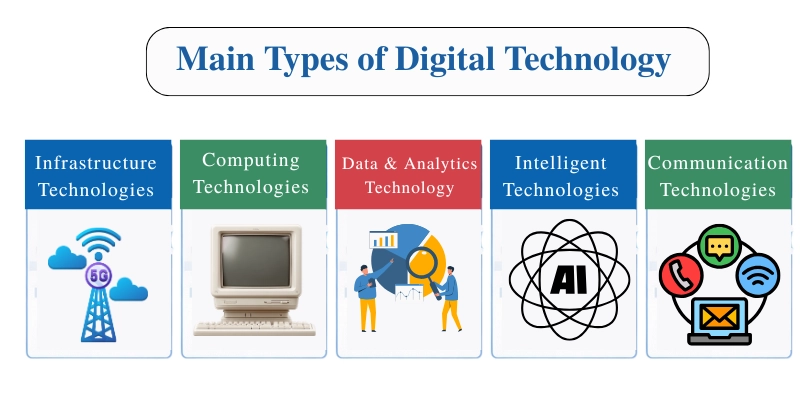
Digital technology functions as a multi-layered system. With each type playing a unique role, some deliver internet access and storage, others process data, while many enable systems to be smart or secure.
Let’s explore each category in clear words.
Infrastructure Technologies
Infrastructure technologies form the foundation of the digital world. They give us connectivity, storage, and computing power. Let’s start by looking at some key examples of these technologies.
1. 5G Networks
Currently, the fastest mobile network is 5G which is fast and has low delay which delivers a high-speed internet. To illustrate, smart cities make use of 5G to control real time traffic lights.
With high-speed networks, smart systems and devices of the IoT do not stutter.
2. Cloud Computing
Cloud computing allows individuals to store and access data via the internet rather than the local computers. As an example, files can be stored in the Google drive or AWS in the cloud.
This is important since expansion of business will be easily achieved without the need of purchasing costly hardware. Elaborating the concept of data processing, now, we will discuss edge computing.
3. Edge Computing
Edge computing works on the data produced locally rather than location far away from a central server.
As an example, self-driving vehicles develop information within the vehicle. That is, edge means the processing data in which it is produced. This is important in that it minimizes the waiting time and enhances speed.
4. Computer Networks
Computer networks are used to connect the devices in order to exchange information. The greatest example is on the internet. The networks are important in that they enable communication among people, systems, and organizations.
Computing Technologies
Computing technologies handle digital information with hardware and software. They act as the brain of all digital systems. Let’s break down the main types.
1. Computers
Computers include desktops, laptops, and servers. They run software and applications. For example, kids can get help with their online work in the school computer lab. Computers matter because they process data and power digital systems.
2. Quantum Computing
Quantum computing solves complex problems faster than normal computers. Researchers use it for tasks like drug discovery. Quantum computers matter because some problems are too complex for classical computers.
3. Embedded Systems
Embedded systems are small chips inside machines. Cars, washing machines, and smart devices all use them. They matter because they control functions that keep devices smart and operational.
Data & Analytics Technologies
Data technologies collect, manage, and analyze information. They turn raw data into insights. Let’s explore the main types.
1. Big Data
Big data processes vast data of apps, websites and devices. Social media such as that, gathers their user activity in order to know what is trending. It is utilized by companies to analyze how people act and advance services.
2. Data Analytics
Data analytics identifies trends and insights of the data gathered. Online retailers, such as those, analyze a shopping history to recommend merchandise. The reason why analytics is important is that it helps businesses to make better decisions.
Information systems are constructed based on analytics and offer an architecture upon which to utilize and manage data.
3. Information Systems
The information systems are a combination of information, hardware, and software to administer operations. An example of this is banks which keep track of customer accounts and transactions.
Hospitals are supported in terms of patient records maintenance whereas airlines are supported in terms of flight schedules and reservations. Such systems are important since they store and keep important information.
Intelligent Technologies
Intelligent technologies make systems smart. They use AI and automation to improve efficiency. Let’s explore the key types.
1. Artificial Intelligence (AI)
AI allows machines to think and learn like humans. For example, voice assistants like Siri use AI to understand commands and respond. AI is important because it speeds up decision-making and improves accuracy. Building on this concept, machine learning is a specific type of AI.
2. Machine Learning
Machine learning teaches systems to learn from your data. For example, when you watch Netflix, it recommends movies based on your viewing history. This matters to you because it personalizes your experiences. Moving from learning to action, automation is another key capability.
3. Automation
Automation completes tasks without your effort. For instance, when you ask questions online, chatbots answer instantly. Automation matters to you because it saves your time and reduces your errors.
4. Robotics
Robotics combines machines and AI to perform physical tasks. Robots, for example, assemble cars in factories. Robotics matters because it increases productivity and consistency.
Communication Technologies
Communication technologies let people share information digitally. They keep teams connected and ideas flowing. Let’s look at the main types.
1. Email
Email sends messages online quickly. Businesses use it for official communication and documentation. Email matters because it provides fast, professional contact.
2. Social Media
Social media connects people globally. Platforms like Facebook and LinkedIn link users for personal and professional purposes. Social media matters because it supports marketing and global communication.
3. Messaging Apps
Beyond social media, messaging apps enable instant communication. Tools like WhatsApp and Slack help teams collaborate in real time. Messaging apps matter because they speed up communication and improve teamwork.
4. Video Conferencing
Video conferencing allows online meetings. Schools and companies use Zoom and Microsoft Teams daily. Video conferencing matters because it supports remote work and learning efficiently.
Immersive & Simulation Technologies
Immersive technologies create digital experiences and simulations. They let users interact with virtual and real-world data. Let’s explore the main types.
1. Augmented Reality (AR)
AR adds digital elements to the real world. For example, furniture apps show how a sofa fits in your room. This connection between digital and real environments improves customer experience and decision-making. Transitioning from AR, we find another immersive technology which is called Virtual Reality (VR).
2. Virtual Reality (VR)
VR creates fully digital environments. Gamers use VR headsets to explore virtual worlds. VR matters because it supports training, education, and entertainment effectively. In addition to VR, another key technology is the digital twin.
You can Read Virtual reality quotes👇👇
3. Digital Twin
A digital twin copies real objects or systems digitally and can incorporate AR or VR to visualize data or simulations. Factories use digital twins to test machines before building them. Digital twins matter because they cut costs and lower risks.
Comparison of Main Types of Digital Technology
A comparison table helps readers understand differences quickly. It also makes the content easier to scan and improves SEO.
Here’s a clear breakdown of each digital technology category.
| Category | Examples | Purpose | Used In |
|---|---|---|---|
| Infrastructure Technologies | 5G networks, Cloud computing, Edge computing, Computer networks | Provide connectivity, storage, and computing power | All industries, telecom, IT services |
| Computing Technologies | Computers, Quantum computing, Embedded systems | Process digital data and run software | Schools, research labs, factories, offices |
| Data & Analytics Technologies | Big data, Data analytics, Information systems | Analyze data and support decision-making | Business, healthcare, finance |
| Intelligent Technologies | Artificial intelligence, Machine learning, Automation, Robotics | Make systems smart and automate tasks | Manufacturing, retail, healthcare |
| Communication Technologies | Email, Social media, Messaging apps, Video conferencing | Enable digital communication and collaboration | Corporate offices, education, marketing |
| Immersive & Simulation Technologies | Augmented reality, Virtual reality, Digital twin | Create interactive digital experiences and simulations | Gaming, training, manufacturing |
| Security & Trust Technologies | Cybersecurity, Blockchain | Protect data and ensure secure transactions | Banking, e-commerce, IT systems |
Types of Digital Technology by Industry
Digital technology does not work the same way in every field. Each industry uses different tools based on its needs. Understanding how digital technology works in real life helps you see its true value.
Let’s explore how different industries use digital systems today.
Digital Technology in Education
Schools and colleges now rely heavily on digital tools. These tools make learning easier and more interactive. Let’s explore the key types of technology in educational industry.
E-learning Management System (LMS)
LMS platforms assist teachers in the management of lessons and assignments through the internet. Google Classroom and Moodle provide an example where students can access the materials at any time.
LMS is significant in its role in ensuring ease of learning and students being kept in check. There are other other technologies that are useful in classroom teaching.
Using Digital Tools in the Classroom.
The digital tools build interactive and interesting lessons. Educational applications, tablets, and smart boards would allow educators to evaluate learners in real-time. Such tools are relevant since they increase participation and understanding.
Online Learning Platforms
Online resources offer distance learning. The Coursera and Khan Academy provide a home learning opportunity where students can take up video classes. The importance of online learning is that it is flexible and has access to international resources.
Digital Technology in Healthcare
Healthcare uses digital systems to improve patient care and safety. These tools help doctors, hospitals, and patients work smarter. Let’s explore the key types.
Computerized (Electronic) Health Records (EHR)
Patient data is stored in EHR in digital format. Electronic records of patients are substituted by paper files in hospitals. The doctors will be able to access the medical history instantly leading to better care and errors.
Telemedicine
Telemedicine is the possibility of visiting the doctor remotely. Video calls will enable patients in rural settings to receive medical consultation. Telemedicine is important as it creates access to healthcare.
Artificial Intelligence in Healthcare.
AI assists physicians to identify diseases on medical scans. In particular, AI is able to detect the manifestations of cancer. AI is important since it enhances speed and accuracy of diagnoses.
Wearable Devices
Wearables are a real-time health tracker. For example, smartwatches will track the heart rate, steps and sleep. Wearables are important since they allow individuals to deal with their health day by day.
Digital Technology in Business
Businesses use digital technology to grow faster and work smarter. These tools help companies reach customers, manage data, and make decisions. Let’s look at the key types.
Cloud Computing
Cloud computing transforms how businesses store data online. Platforms like AWS, Google Cloud, and Microsoft Azure replace expensive hardware. Cloud adoption enables companies to scale easily and reduce costs.
Customer Relationship Management (CRM) Systems
CRM systems are essential for tracking customer interactions and sales. Tools like Salesforce and HubSpot let teams manage leads and follow-ups efficiently. Strong CRM practices strengthen customer relationships and boost revenue.
Digital Marketing Tools
Effective digital marketing tools allow businesses to reach customers online. Social media, email campaigns, search engine optimizers, and ads help promote products. Marketing tools matter because they increase visibility and engagement.
Data Analytics
Data analytics examines customer behavior and trends. Companies analyze purchases to improve products and services. Analytics matters because it guides smarter business decisions.
Conclusion
In this article, we explored the main types of digital technology, from infrastructure and computing to AI, communication, and immersive systems. We also looked at how industries like education, healthcare, and business use these tools to work smarter and stay connected.
I recommend that you pay attention to these technologies because understanding them can help you make better decisions, improve productivity, and stay ahead in today’s digital world.
So, guys, keep exploring these tools, stay curious, and keep learning about how digital technology shapes our daily lives.
Frequently Asked Questions (FAQs)
Digital technology uses machines and programs to handle, save, and share information. It includes things like computers, online storage, smart programs, and ways to talk with others online.
Digital technology powers industries, education, healthcare, and businesses, helping them work faster, smarter, and more efficiently.
Infrastructure technology forms the foundation for all digital systems. It provides connectivity, data storage, and computing resources. Without strong infrastructure, other technologies such as AI, cloud platforms, and smart devices cannot operate effectively.
Businesses, phone companies, and IT services use it every day.
AI analyzes data and automates processes for businesses. It improves decision-making, predicts customer behavior, and personalizes experiences.
Companies can save time, cut down on mistakes, and get more done in marketing, sales, and operations with tools like chatbots, suggestion engines, and prediction analytics.
Cloud computing stores and accesses data online. Companies no longer need expensive hardware. Platforms like AWS and Google Cloud let businesses scale operations quickly, support remote work, and access data securely from anywhere in the world.
AR and VR create interactive digital experiences in different ways. AR overlays digital elements onto the real world, while VR immerses users in virtual environments. Industries use these technologies to engage customers, train employees, and safely simulate real-world scenarios in retail, training, and gaming.




- Be Respectful
- Stay Relevant
- Stay Positive
- True Feedback
- Encourage Discussion
- Avoid Spamming
- No Fake News
- Don't Copy-Paste
- No Personal Attacks
- Be Respectful
- Stay Relevant
- Stay Positive
- True Feedback
- Encourage Discussion
- Avoid Spamming
- No Fake News
- Don't Copy-Paste
- No Personal Attacks
