Explore 10 Must-Know Examples of Information Technology You Can’t Ignore
Published: 31 Jan 2026
Are you curious about Information Technology (IT) and how it shapes our digital world? Understanding different examples of IT can help you see how it affects everything from the devices we use to the systems that run businesses.
In this article, we will explore some key examples of Information Technology and how they function.
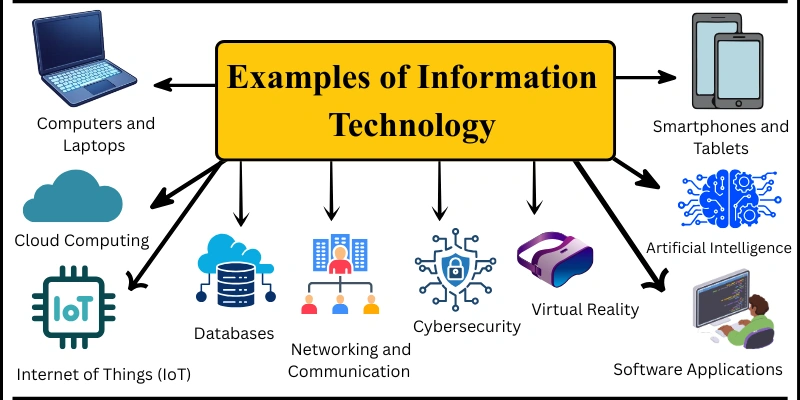
10 Examples of Information Technology
Almost all of the tools and technologies we use today are based on information technology. Anything that helps collect, process, and share data is part of this technology.
Here are some well-known examples of Information Technology:
1. Computers and Laptops
2. Smartphones and Tablets
3. Cloud Computing
4. Internet of Things (IoT)
5. Artificial Intelligence (AI)
6. Software Applications
7. Databases
8. Networking and Communication Systems
9. Cybersecurity Systems
10. Virtual Reality (VR)
1. Computers and Laptops
Some of the most popular IT products are computers and laptops. People can use them for storing data, running programs, and browsing the web.
They can handle a lot of different tasks in personal, educational, or professional areas because they have powerful processing speeds.
Popular Examples:
- Personal Computers (PCs): Devices used for everyday work and productivity.
- Gaming Laptops: Devices built for high-performance gaming use.
- MacBook: Devices running macOS are used for productivity and creative tasks.
- Chromebooks: Devices running Chrome OS for lightweight computing tasks.
- Workstations: Devices used for professional tasks like 3D rendering.
2. Smartphones and Tablets
Mobile Operating Systems like Android and iOS run on devices such as iPhones, Samsung Galaxy smartphones, iPads, and MacBooks.
They help us work, play games, stay in touch, and use different services while we are out and about by bringing together devices and software.
Popular Examples:
- Android Smartphones: Devices that operate on Google’s Android operating system.
- iPhones: Devices that operate on Apple’s iOS operating system.
- Samsung Galaxy Tablets: Devices that operate on Google’s Android operating system.
- iPads: Devices that operate on Apple’s iOS operating system.
- Foldable Phones: Devices that operate on Android, iOS, or other operating systems and feature foldable screens.
3. Cloud Computing
Cloud computing uses remote servers via the internet for data storage, management, and processing. Instead of local servers or PCs, users access information and applications from anywhere, often letting mobile operating systems sync and interact with cloud services.
Popular Examples:
- Public Cloud: Cloud services like AWS and Google Cloud are used by anyone for hosting websites or apps.
- Private Cloud: Dedicated cloud infrastructure for a single organization, such as a company’s internal data center.
- Hybrid Cloud: A combination of public and private cloud systems for web traffic and private cloud for sensitive data.
- Cloud Storage: Services like Google Drive and Dropbox for storing and sharing files online, such as storing photos, documents, or backups.
- Cloud Computing Platforms: Platforms like Microsoft Azure are used for running business applications and services online.
4. Internet of Things (IoT)
IoT lets everyday things connect and communicate with each other through the internet, enabling them to share and collect information.
Devices such as smart thermostats, wearable tech, connected home products, and fitness trackers like the Apple Watch Series transmit data to each other and to cloud services for analysis.
Popular Examples:
The following are common examples of devices and technologies enabled by the Internet of Things:
- Smart Home Devices: Devices such as thermostats and lights that are controlled remotely.
- Wearables: Devices such as smartwatches and fitness trackers used for health and activity monitoring.
- Smart Appliances: Refrigerators, washing machines, and ovens connected to the internet for remote management.
- Connected Cars: Vehicles equipped with internet and smart systems to provide navigation and connectivity.
- Industrial IoT: Applications in manufacturing that enable automation and improve efficiency.
5. Artificial Intelligence (AI)
AI uses algorithms and data to duplicate human intelligence and carry out activities such as decision-making, problem-solving, and language translation.
AI is becoming an essential component of many systems, ranging from chatbots to self-driving automobiles.
Popular Examples:
- Machine Learning: A type of artificial intelligence (AI) that learns from data and improves its performance over time without explicit programming, often used to solve complex real-world problems.
- Natural Language Processing (NLP): A branch of AI focused on enabling computers to understand, interpret, and respond to human language.
- Autonomous Vehicles: Vehicles controlled by artificial intelligence systems that operate and navigate without human input.
- Chatbots: Computer programs that use artificial intelligence (AI) to interact with customers and provide support.
- AI in Healthcare: Artificial intelligence (AI) systems that assist doctors by analyzing medical data, diagnosing illnesses, and developing treatment plans using advanced algorithms.
6. Software Applications
Software applications are programs that help people perform tasks on devices such as computers or phones. Examples include simple tools like word processors and more advanced programs for running a business.
Popular Examples:
- Productivity Software: Tools such as Microsoft Office and Google Docs.
- Graphic Design Software: Programs like Adobe Photoshop and Illustrator are used for creating and editing visual graphics.
- Video Editing Software: Software like Adobe Premiere Pro and Final Cut Pro, used to edit and produce videos.
- Web Browsers: Browsers like Google Chrome, Mozilla Firefox, and Safari are used for accessing and navigating the internet.
- Communication Software: Applications like Zoom and Slack are used for team communication and collaboration.
7. Databases
Databases are tools for storing, managing, and retrieving huge volumes of structured data. They are essential for organizations that need to keep track of their customers, products, or transactions.
Popular Examples:
- Relational Databases: Systems like MySQL and PostgreSQL that store structured data using tables with predefined schemas.
- NoSQL Databases: Databases such as MongoDB and Cassandra for storing data that does not fit into a fixed schema, such as documents or key-value pairs.
- Data Warehouses: Systems such as Amazon Redshift for storing and analyzing large volumes of structured data.
- Cloud Databases: Databases hosted on cloud platforms like AWS and Azure that offer scalable storage and managed services.
- In-memory Databases: Databases like Redis that use memory for fast data storage and retrieval, optimizing performance.
8. Networking and Communication Systems
Networking means linking computers, phones, printers, and other devices so they can work together and share information. This lets people connect across the world using Wi-Fi, the internet, and other tools.
Networking also forms the foundation for many emerging technologies, including those that offer immersive experiences.
Popular Examples:
- LAN (Local Area Network): A network connecting devices within a small area, such as connecting computers and printers in one office building.
- WAN (Wide Area Network): A network that connects locations across large geographic areas, such as branch offices in different cities.
- VPN (Virtual Private Network): A technology that provides secure remote access to the internet, enabling employees to connect securely to company resources from home.
- Wi-Fi: Wireless technology that allows devices, like laptops or smartphones, to connect to the internet without physical cables. For example, a laptop connecting to a home router uses Wi-Fi.
- 5G Networks: The most recent generation of mobile networks, known as ‘fifth generation’ (5G), offers increased speeds for activities such as streaming high-definition video on smartphones.
9. Cybersecurity Systems
Cybersecurity means protecting information and devices from online dangers, such as viruses. It includes using antivirus software to detect and remove malware and to keep information and devices safe.
As technology advances, both cybersecurity and new forms of interaction, such as virtual reality, have become increasingly important.
Popular Examples:
- Antivirus Software: Programs like Norton and McAfee that help protect your computer from harmful software.
- Firewalls: Tools that check and manage what comes in and out of your computer’s network.
- Encryption: Ways of making information unreadable to anyone except approved people.
- Multi-factor Authentication (MFA): A safety system that asks for more than just a password to prove who you are.
- Penetration Testing: Allowing experts to try breaking into your system to find weaknesses.
10. Virtual Reality (VR)
Virtual reality is an advanced technology that lets people interact with computer-made settings as if they were really there. People use it for fun, training, and learning.
Popular Examples:
- VR Headsets: Devices such as Oculus Rift and HTC Vive that allow users to experience and interact with immersive virtual environments.
- VR Gaming: Engages players in interactive and immersive gaming by placing them inside virtual worlds.
- VR Training Simulations: Provides realistic practice environments in fields like medicine and aviation, allowing users to develop skills safely.
- Virtual Tours: Enable individuals to explore locations such as museums or real estate properties remotely using VR technology.
- VR Therapy: Applies virtual reality experiences to support mental health treatments such as exposure therapy and relaxation techniques.
Questions People Ask About Information Technology
Here are some key areas where Information Technology is utilized in our daily lives.
Here is a list of some examples of information technology that we can use in everyday life:
- Online banking systems
- E-commerce websites
- Social media platforms
- GPS navigation systems
- Healthcare management systems
- ATM machines
- Smart home systems
- Email services
- Online education platforms
- Retail point-of-sale (POS) systems
Information Technology (IT) brings together computers, software, networks, and more to help us process, store, and share information with speed and ease.
IT includes technologies that manage data and improve communication, automation, and problem-solving in various sectors, such as business, healthcare, and entertainment.
Cloud computing works by enabling on-demand access to computer resources (such as servers, storage, and applications) through the internet.
Users can access both hardware and software from data centers operated by companies like Amazon AWS, Microsoft Azure, and Google Cloud. As a result, they do not need to maintain their own physical hardware and software.
The main types of databases are:
- Relational Databases
- NoSQL Databases
- In-memory Databases
- Graph Databases
- Object-oriented Databases
Yes, you can use AI in your business for customer service, data analysis, automation, and decision-making.
AI can be used to make things like chatbots for customer service, advanced analytics for marketing, machines that do boring tasks automatically, and even personalized suggestions that make the user experience better.
Yes, there are many free software applications available. Some examples are:
- LibreOffice (open-source office suite)
- GIMP (image editing)
- Audacity (audio editing)
- Firefox (web browser)
- VLC Media Player (media player)
A lot of free apps have lots of useful features, and some open-source apps let users help make them better.
Conclusion
Information technology can be found everywhere, from the items we use on a daily basis to the advanced technologies that power large businesses. Understanding these Examples of information technology can help you better understand how IT affects your life and job.
If you’re new to the IT field, evaluate any of these technologies to see how they match your needs!



- Be Respectful
- Stay Relevant
- Stay Positive
- True Feedback
- Encourage Discussion
- Avoid Spamming
- No Fake News
- Don't Copy-Paste
- No Personal Attacks
- Be Respectful
- Stay Relevant
- Stay Positive
- True Feedback
- Encourage Discussion
- Avoid Spamming
- No Fake News
- Don't Copy-Paste
- No Personal Attacks
